PMO Meaning | What Does PMO Mean and How Does It Work?
If you came across PMO in a job description, project meeting, company document, or business article, you may be wondering what it actually means.
In project management, PMO usually stands for Project Management Office. It is a team or function that helps an organization manage projects in a more consistent way. A PMO can set project standards, organize reporting, support project managers, manage resources, and help leadership see what is happening across multiple projects.
The exact role of a PMO depends on the organization. Some PMOs mainly provide guidance and tools. Others have the authority to enforce processes or directly manage projects.
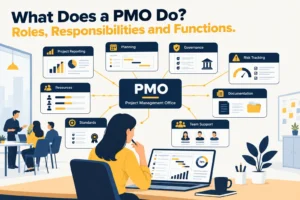
What Does a PMO Do? Roles, Responsibilities and Functions
What Is a PMO in Project Management?
PMO Full Form: What Does PMO Stand For?
What Does PMO Mean?
In a business or project management context, PMO means Project Management Office.
You may also see PMO used for Programme Management Office or Portfolio Management Office. The meaning depends on the level at which the function operates.
| PMO | Full Form | Main Focus |
|---|---|---|
| PMO | Project Management Office | Supporting and governing projects |
| PMO | Programme Management Office | Coordinating related projects within a programme |
| PMO | Portfolio Management Office | Managing projects and programmes as a strategic portfolio |
PMO can also mean something completely different outside project management. For example, in India, PMO commonly refers to the Prime Minister’s Office. On social media and in text messages, PMO can also be used as slang.
This page focuses mainly on PMO in project management and business.
What Is a PMO?
A Project Management Office is a team or organizational function that helps standardize the way projects are planned, managed, monitored, and reported.
Think about a company running 20 projects at the same time. Without some shared system, each project manager might use different templates, reporting methods, tools, and processes. Leadership may then have a hard time comparing projects or spotting problems early.
A PMO helps bring some consistency to that work.
Depending on the organization, it may provide project templates, reporting standards, planning support, governance, training, resource coordination, and project management tools.
A PMO does not necessarily manage every project itself. In many organizations, project managers remain responsible for delivering individual projects while the PMO provides the structure and oversight around them.
What Does a PMO Do?
There is no single list of responsibilities that applies to every PMO. A small PMO may focus on reporting and administration, while a larger enterprise PMO may have a much wider role.
Common PMO responsibilities include:
Setting Project Standards
A PMO can establish common processes for starting, planning, executing, monitoring, and closing projects. This gives project teams a shared way of working.
Project Reporting
A PMO can collect project information and turn it into reports or dashboards for management. Instead of receiving updates in completely different formats, leadership gets a more consistent view of project progress.
Resource Planning
When several projects need the same people, budget, or other resources, conflicts can happen quickly. A PMO can help identify those conflicts and give decision-makers a clearer picture of available capacity.
Risk and Issue Management
PMOs may track major project risks and issues across multiple projects. This makes it easier to identify problems that could affect more than one team or project.
Project Governance
Governance defines how important project decisions are made and how projects are monitored. A PMO may establish approval processes, review points, reporting requirements, and other controls.
Templates and Tools
Project teams often need the same basic documents and tools repeatedly. A PMO can maintain templates for project plans, status reports, risk registers, meeting records, and other project documentation.
Training and Support
Some PMOs help project managers and teams improve their skills through training, coaching, guidance, or access to shared project knowledge.
PMO vs Project Manager
PMO and project manager are related, but they are not the same thing.
The easiest way to understand the difference is to look at their scope.
| Project Manager | PMO | |
|---|---|---|
| Main focus | A specific project | Multiple projects or the wider organization |
| Responsibility | Project delivery | Standards, governance, support, and oversight |
| Scope | Usually one project | Can cover many projects |
| Daily work | Managing tasks, people, timelines, and stakeholders | Supporting consistency, reporting, processes, and decisions |
| Goal | Deliver the assigned project successfully | Improve how projects are managed across the organization |
A project manager might be responsible for launching a new website by a certain date.
The PMO may be responsible for making sure that website project follows the organization’s project process, reports progress correctly, manages risks consistently, and fits within the company’s wider priorities.
The two functions can work very closely together.
Types of PMO
Not every organization needs the same type of PMO. The level of control can range from providing optional support to taking direct responsibility for project delivery.
Supportive PMO
A supportive PMO mainly provides guidance, templates, training, tools, and best practices.
Project teams generally have more freedom in how they work. The PMO helps rather than controls.
This model can work well when teams are experienced but would benefit from shared resources and better consistency.
Controlling PMO
A controlling PMO has more authority.
It may require teams to follow specific project management processes, use approved templates, submit regular reports, or pass through defined review points.
This approach can be useful when an organization needs stronger consistency, oversight, or compliance.
Directive PMO
A directive PMO takes a much more hands-on role.
It may directly manage projects and provide or assign project managers. Instead of simply telling teams how projects should be managed, the PMO becomes directly involved in managing the work.
Programme Management Office
A Programme Management Office focuses on a group of related projects.
The individual projects may each have their own project managers, while the programme-level PMO looks at how those projects fit together, including dependencies, resources, risks, and shared objectives.
Portfolio Management Office
A Portfolio Management Office takes a broader business view.
Instead of asking only whether individual projects are being delivered properly, it looks at the organization’s overall collection of projects and programmes.
Questions might include:
- Are we investing in the right projects?
- Are resources being used where they matter most?
- Which projects should receive more attention?
- Are projects still aligned with business priorities?
External PMO
Some organizations bring in an outside company or specialist team to provide PMO services.
An external PMO may be used during a major transformation, merger, technology programme, or other period when an organization needs additional project management capability without building a permanent internal team.
PMO Roles
The people working in a PMO depend on its size and responsibilities.
A small PMO might have only a few people, while a large organization may have an entire team with different specialties.
PMO Director
A PMO director typically leads the function and works with senior leadership on project governance, strategy, and organizational priorities.
PMO Manager
A PMO manager usually handles the day-to-day operation of the PMO. This can include managing reporting, processes, resources, tools, and support for project teams.
PMO Analyst
A PMO analyst works with project data. This may include tracking progress, budgets, risks, resources, and other information used in project reports and dashboards.
PMO Coordinator
A PMO coordinator can handle the operational side of the function, such as maintaining documents, organizing meetings, tracking actions, and supporting project processes.
The structure varies widely, so not every PMO will have all of these positions.
What Are the Benefits of a PMO?
A PMO can be useful when an organization has enough projects, teams, or complexity that managing everything independently becomes difficult.
Some common benefits include:
Better Visibility
Leadership can get a clearer view of project status, risks, resources, and priorities instead of relying on separate updates from individual teams.
More Consistent Processes
Shared processes and templates can make it easier for different teams to plan and report their work in a consistent way.
Better Resource Coordination
A PMO can help identify situations where several projects are competing for the same people, budget, or other resources.
Earlier Risk Identification
When project information is collected centrally, risks and issues can sometimes be identified before they become larger problems.
Stronger Connection Between Projects and Business Goals
A project should have a reason for existing. At the portfolio level, a PMO can help leadership see whether projects are still supporting the organization’s priorities.
Shared Knowledge
Lessons learned, templates, processes, and useful project information can be kept in one place rather than being lost when a project ends or someone leaves the organization.
What Does PMO Mean in Business?
In business, PMO generally refers to the function responsible for helping an organization manage projects in a structured way.
The role becomes particularly useful when a company has many projects happening at the same time.
For example, imagine a company working on a new product launch, an internal software migration, a regulatory project, and an office expansion at the same time.
Each project has different people and deadlines, but they may compete for the same resources.
A PMO can give leadership a common view of those projects and help establish a consistent approach to planning, reporting, risk management, and decision-making.
This is why a PMO is often positioned between strategy and execution. Business leaders decide what the organization wants to achieve, while projects are the work that turns those goals into something tangible. A PMO can help connect the two.
How Does a PMO Work?
What Is a PMO?
The exact process varies, but a PMO often becomes involved throughout the project lifecycle.
A typical process may look like this:
1. Project initiation: The project is proposed, its purpose is defined, and the organization decides whether it should move forward.
2. Planning: The team defines the scope, schedule, resources, budget, risks, and other requirements.
3. Execution: The project team performs the planned work while tracking progress against its goals.
4. Monitoring: Progress, costs, risks, issues, and changes are reviewed throughout the project.
5. Reporting: Relevant information is shared with project sponsors, management, or other stakeholders.
6. Closure: The project is completed, results are reviewed, documentation is finalized, and useful lessons can be recorded for future work.
A PMO may support or oversee some or all of these stages depending on its role.
Does Every Company Need a PMO?
No. A small company running a few straightforward projects may not need a dedicated PMO. Adding another layer of processes could create more work than value.
A PMO becomes more useful when an organization has multiple projects, competing priorities, complex dependencies, significant budgets, regulatory requirements, or a need for consistent project reporting.
The question is not simply whether a company is large enough to have a PMO. The better question is whether the organization has a project management problem that a PMO can actually solve.
When Does a PMO Make Sense?
A PMO may be worth considering when:
- Multiple projects compete for the same resources
- Project reporting is inconsistent
- Leadership lacks a clear view of project progress
- Projects regularly miss deadlines or budgets
- Teams use completely different project processes
- Important project risks are discovered too late
- Business priorities change faster than project decisions
- Lessons from completed projects are not being carried forward
A PMO should solve a real problem. If it only creates forms, meetings, and approval steps without helping teams deliver better work, people will quickly see it as unnecessary bureaucracy.
PMO Meaning in Text and Slang
If you saw PMO in a text message, TikTok comment, or social media post, the meaning may be different from Project Management Office.
Online, PMO is commonly used as slang and can have different interpretations depending on the sentence and context.
For example, someone searching “PMO meaning in text” is usually asking about the informal use rather than project management.
We cover that separately in our guide to PMO meaning in slang.
Final Takeaway
PMO usually means Project Management Office when you’re talking about business or project management.
Its job is not necessarily to manage every project. Instead, a PMO creates the structure around project delivery through standards, reporting, governance, resources, tools, and support.
The right PMO should make projects easier to understand and manage, not simply add another layer of paperwork. How much authority it needs depends on the organization’s size, culture, project complexity, and the problems it is trying to solve.